Đột phá trong minh giải tài liệu địa chấn 3D để phát hiện các bẫy chứa địa tầng
Tóm tắt
Bài báo giới thiệu phương pháp minh giải địa chấn toàn phần (global seismic interpretation method) được phát triển bởi Pauget và nnk. [1]. Mô hình 3D thời gian địa chất tương đối (3D relative geologic time, RGT) được xây dựng trực tiếp từ tài liệu địa chấn là kết quả của phương pháp này. Trong mô hình RGT, tuổi địa chất có sự tiếp diễn liên tục, được nội suy và xác định trên mọi điểm của tài liệu địa chấn 3D.
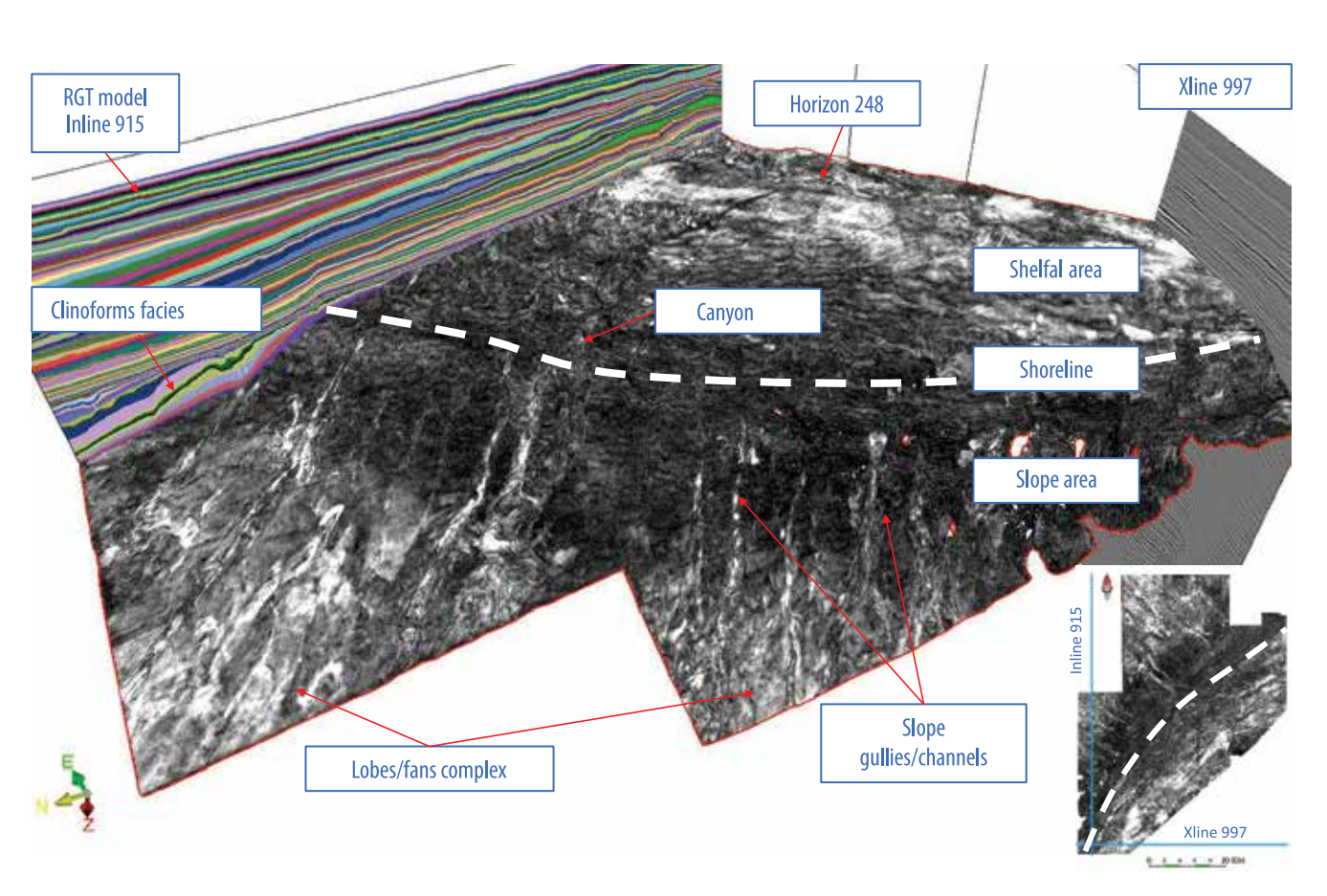
Tài liệu sử dụng trong nghiên cứu này là khối địa chấn Maui 3D, bể trầm tích Taranaki, ngoài khơi New Zealand. Mô hình RGT với số lượng 400 mặt phản xạ được đưa ra nhanh chóng trong quá trình minh giải. Kết quả cho thấy rõ ràng và chi tiết các đặc điểm địa chất ngay cả với khu vực địa chất phức tạp mà phương pháp minh giải địa chấn truyền thống khó minh giải. Ngoài ra, việc tích hợp các thuộc tính địa chấn (như Root Mean Square - RMS, Spectral Decomposition…) cho phép minh giải chi tiết hơn về địa tầng, chính xác hóa các yếu tố về cấu trúc địa chất, đặc trưng vỉa chứa và môi trường cổ trầm tích, từ đó có thể phát hiện các bẫy chứa địa tầng.
Các tài liệu tham khảo
Fabien Pauget, Sébastien Lacaze, and Thomas Valding, “A global approach to seismic interpretation based on cost function and minimization”, SEG Technical Program Expanded Abstracts 2009. DOI: 10.1190/1.3255384.
Hilde G. Borgos, Thorleif Skov, Trygve Randen, and Lars Sonneland, “Automated geometry extraction from 3D seismic data”, SEG Technical Program Expanded Abstracts 2003. DOI: 10.1190/1.1817590.
Paul de Groot, Arnaud Huck, Geert de Bruin, Nanne Hemstra, and Jonathan Bedford, “The horizon cube: A step change in seismic interpretation”, The Leading Edge, Vol. 29, No. 9, pp. 1048 - 1055, 2010. DOI: 10.1190/1.3485765.
H.J. Ligtenberg, G. de Bruin, N. Hemstra, and C. Geel, “Sequence stratigraphic interpretation in the wheeler transformed (flattened) seismic domain”, 68th EAGE Conference and Exhibition Incorporating SPE EUROPEC 2006. DOI: 10.3997/2214-4609.201402337.
Jesse Lomask, Antoine Guitton, Sergey Fomel, Jon Claerbout, and Alejandro A. Valenciano, “Flattening without picking”, Geophysics, Vol. 71, No. 4, pp. 13 - 20, 2006. DOI: 10.1190/1.2210848.
Xinming Wu and Dave Hale, “Horizon volumes with interpreted constraints”, Geophysics, Vol. 80, No. 2, 2015. DOI: 10.1190/geo2014-0212.1.
Tracy J. Stark, “Relative geologic time (age) volumes - Relating every seismic sample to a geologically reasonable horizon”, The Leading Edge, Vol. 23, No. 9, pp. 928 - 932, 2004. DOI: 10.1190/1.1803505.
Peter R. King, “Tectonic reconstructions of New Zealand: 40 Ma to the present”, New Zealand Journal of Geology and Geophysics, Vol. 43, No. 4, pp. 611 - 638, 2000. DOI: 10.1080/00288306.2000.9514913.
P.R. King and Glenn P. Thrasher, “CretaceousCenozoic geology and petroleum systems of the Taranaki basin, New Zealand”, Institute of Geological and Nuclear Sciences, Vol. 13, No. 2, 1996.
K.E Higgs, P.R. King, J.I Raine, R. Sykes, G.H Browne, E.M Crouch, J.R Baur, “Sequence stratigraphy and controls on reservoir sandstone distribution in an Eocene marginal marine-coastal plain fairway, Taranaki Basin, New Zealand”. Marine and Petroleum Geology, Vol. 32, No. 1, pp. 110 - 137, 2012. DOI: 10.1016/j.marpetgeo.2011.12.001.
Eahsanul Haque, Aminul Islam, and Mohamed Ragab Shalaby, “Structural modeling of the Maui gas field, Taranaki basin, New Zealand”, Journal of Petroleum Exploration and Production Technology, Vol. 43, No. 6, pp. 965 - 975, 2016. DOI: 10.1016/S1876-3804(16)30114-8.
G. Thrasher, H. Seebeck, P. Viskovic, S. Bull, M. Sarma, and K. Kroeger, “Time structure grids for the greater Maui-Maari-Tui region, Taranaki basin, New Zealand”, GNS Science Data Series, 2018.
Ingelise Schmidt, Sebastien Lacaze, and Gaynor Paton, “Spectral decomposition and geomodel interpretation - Combining advanced technologies to create new workflows”, 75th EAGE Conference & Exhibition Incorporating SPE EUROPEC 2013, London, UK, 10 - 13 June 2013. DOI: 10.3997/2214-4609.20130567.
Marco Fonnesu, Denis Palermo, Mauro Galbiati, Marco Marchesini, Enrico Bonamini, and Daniel Bendias, “A new world-class deep-water play-type, deposited by the syndepositional interaction of turbidity flows and bottom currents: The giant Eocene Coral field in northern Mozambique”, Marine and Petroleum Geology, Vol. 111, pp. 179 - 201, 2020. DOI: 10.1016/j.marpetgeo.2019.07.047.
Tony Marsh and Anne Powell, “Regional stratal slice imaging of the Northern Carnarvon basin, Western Australia”, ASEG Extended Abstracts, 2019. DOI: 10.1080/22020586.2019.12073062.
Lia Turrini, Christopher A-L. Jackson, and Philip Thompson, “Seal rock deformation by polygonal faulting, offshore Uruguay”, Marine and Petroleum Geology, Vol. 86, pp. 892 - 907, 2017. DOI: 10.1016/j.marpetgeo.2017.06.038.
Karsten F. Kroeger, Glenn P. Thrasher, and Monmoyuri Sarma, “The evolution of a Middle Miocene deep-water sedimentary system in northwestern New Zealand (Taranaki basin): Depositional controls and mechanisms”, Marine and Petroleum Geology, Vol. 101, pp. 355 - 372, 2019. DOI: 10.1016/j.marpetgeo.2018.11.052.
Nguyễn Xuân Thịnh và Hà Quang Mẫn, “Đột phá trong minh giải tài liệu địa chấn 3D để phát hiện các bẫy chứa địa tầng”, Tạp chí Dầu khí, Số 3, trang 45 - 51, 2021. DOI: 10.47800/PVJ.2021.03-06.
1. Tác giả giao bản quyền bài viết (tác phẩm) cho Tạp chí Dầu khí, bao gồm quyền xuất bản, tái bản, bán và phân phối toàn bộ hoặc một phần tác phẩm trong các ấn bản điện tử và in của Tạp chí Dầu khí.
2. Bằng cách chuyển nhượng bản quyền này cho Tạp chí Dầu khí, việc sao chép, đăng hoặc sử dụng một phần hay toàn bộ tác phẩm nào của Tạp chí Dầu khí trên bất kỳ phương tiện nào phải trích dẫn đầy đủ, phù hợp về hình thức và nội dung như sau: tiêu đề của bài viết, tên tác giả, tên tạp chí, tập, số, năm, chủ sở hữu bản quyền theo quy định, số DOI. Liên kết đến bài viết cuối cùng được công bố trên trang web của Tạp chí Dầu khí được khuyến khích.