Sand production risk prediction in weakly consolidated formations using an integrated geomechanical approach: A case study from Cuu Long basin, offshore Vietnam
Abstract
Sand production during hydrocarbon extraction represents a critical operational challenge, particularly in weakly consolidated formations such as the Miocene sandstones of the Cuu Long basin, offshore Vietnam, leading to production losses, equipment damage, and potential well abandonment. Accurate prediction is essential for optimizing completion design and selecting suitable sand control.
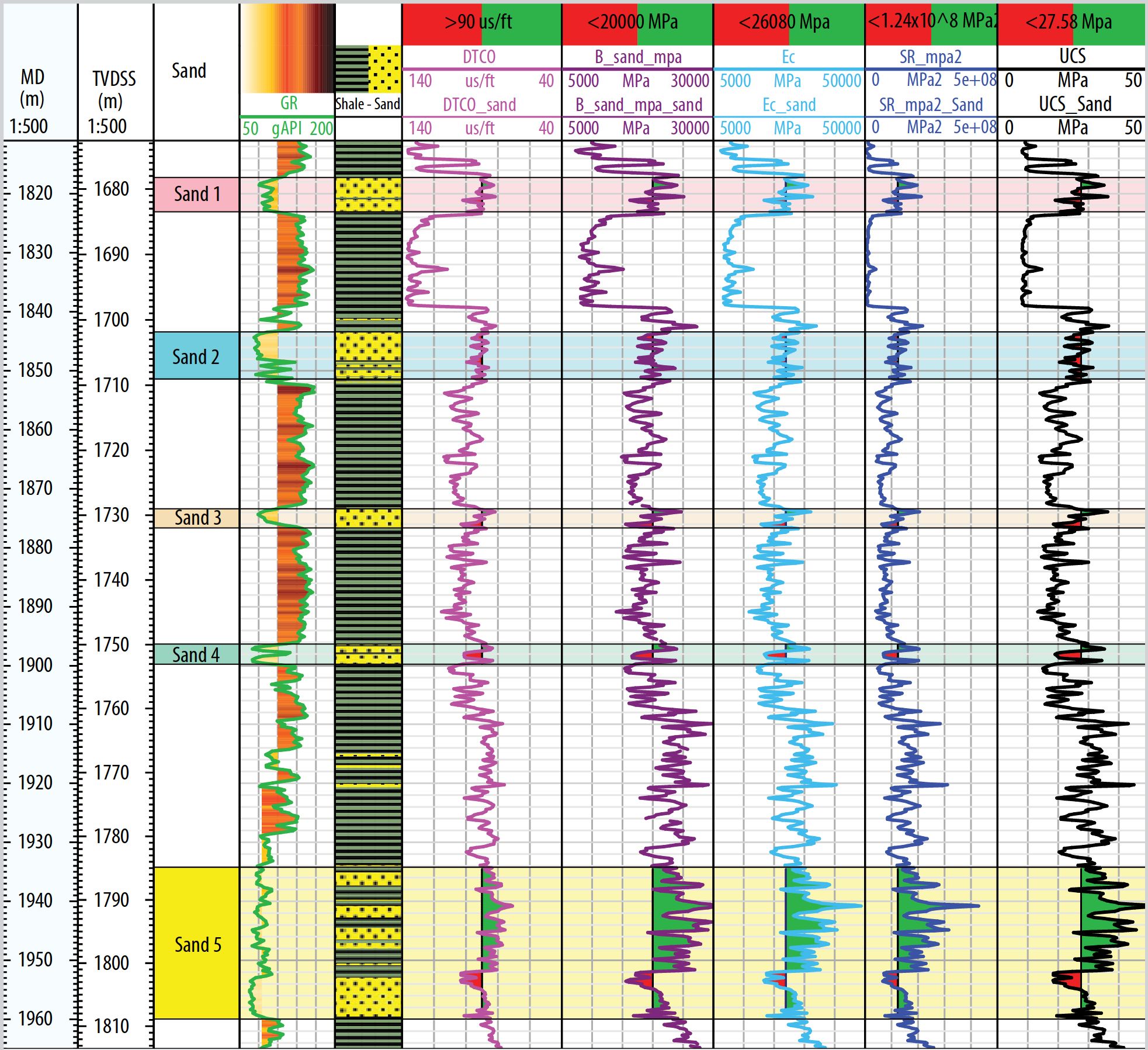
This study presents a multi-index geomechanical approach for predicting sand production risk using five indicators: (1) sonic transit time (DTCO), (2) sand production index - BI, (3) Schlumberger sand production ratio - SR, (4) combined elastic modulus - Ec, and (5) unconfined compressive strength - UCS. These indices are derived from basic well logs (gamma-ray, sonic, and density) and calculated geomechanical parameters.
The methodology was applied to a well in Blocks 01&02 of the Cuu Long basin, where five major sand bodies were subdivided into 15 distinct sub-intervals subject to log response variations. Results reveal substantial intra-sand-body heterogeneity: Sands 1 - 4 consistently exhibit high risk with measured values below critical thresholds, while Sand 5 overall appears low-medium risk. A detailed analysis of Sand 5 indentifies three distinct sub-intervals with dramatically different characteristics. Field validation confirmed prediction accuracy, with 600 psi depletion triggering sand production in the predicted intervals.
Based on these findings, active sand control measures are recommended for all high-risk intervals to ensure safe and sustainable production. The integrated multi-index approach provides enhanced reliability compared to single-criterion methods and can be readily applied to analogous geological settings with similar formation characteristics, offering a cost-effective alternative to extensive core testing programs.
References
T.J. Ajayi, O.Y. Adeogun, and Omeru, “Predicting sanding potential using empirical method in "Ebendo" field, Niger Delta, Nigeria”, Journal of Applied Sciences and Environmental Management, Volume 26, Issue 9, pp. 1557 - 1564, 2022.
Sadegh Asadi, Khalil Rahman, Hoanh V. Pham, Thao Le Minh, and Andy Butt, “Sand production assessment considering the reservoir geomechanics and water breakthrough”, The APPEA Journal, Volume 55, Issue 1, p. 215 - 224, 2015. DOI: 10.1071/aj14016.
I.D.R. Bradford, J. Fuller, P.J. Thompson, and T.R. Walsgrove, “Benefits of assessing the solids production risk in a North Sea reservoir using elastoplastic modelling”, SPE/ISRM Rock Mechanics in Petroleum Engineering, Trondheim, Norway, 8 - 10 July 1998. DOI: 10.2118/47360-MS.
Ma Dong, Bian Long, Li Lun, and Hu Juncheng, “Application of logging data in predicting sand production in oilfield”, Electronic Journal of Geotechnical Engineering, Volume 18, pp. 6173 - 6180, 2013.
Ehsan Khamehchi and Ebrahim Reisi, “Sand production prediction using ratio of shear modulus to bulk compressibility (case study)”, Egyptian Journal of Petroleum, Volume 24, Issue 2, pp. 113 - 118, 2015. DOI: 10.1016/j.ejpe.2015.05.002.
Osaki Lawson-Jack, Etim D. Uko, Iyeneomie Tamunobereton-Ari, and Matthew A. Alabraba, “Geomechanical characterization of a reservoir in part of Niger Delta, Nigeria”, Asian Journal of Applied Sciences and Technology, Volume 3, Issue 1, pp. 10 - 30, 2019.
Khalil Rahman, Abbas Khaksar, and Toby Kayes, “Minimizing sanding risk by optimizing well and perforation trajectory using an integrated geomechanical and passive sand-control approach”, SPE Annual Technical Conference and Exhibition, Denver, Colorado, USA, 21 - 24 September 2008. DOI: 10.2118/116633-MS.
Surej Kumar Subbiah, Lex de Groot, and Hilbrand Graven, “An innovative approach for sand management with downhole validation”, SPE International Symposium and Exhibition on Formation Damage Control, Lafayette, Louisiana, USA, 26 - 28 February 2014. DOI: 10.2118/168178-MS.
Kingsley Maraizu Ogbuagu, Chukwuemeka Ngozi Ehirim, and Tamunonengiyeofori Dagogo, “Evaluation of formation susceptibility and sand production potential in an offshore field, Niger Delta basin, Nigeria”, Energy Geoscience, Volume 5, Issue 1, 2024. DOI: 10.1016/j.engeos.2023.100213.
S.M. Willson, Z.A. Moschovidis, J.R. Cameron, and I.D. Palmer, “New model for predicting the rate of sand production”, SPE/ISRM Rock Mechanics Conference, Irving, Texas, 20 - 23 October 2002. DOI: 10.2118/78168-MS.
Hoàng Thanh Tùng, Lê Thị Hoàng Thi, Trương Hoài Nam, Lê Vũ Quân, và Tạ Văn Cường, “Ứng dụng mô hình giải tích để dự báo khả năng sinh cát của các vỉa khí tầng miocene mỏ Hải Thạch, bể Nam Côn Sơn”, Tạp chí Dầu khí, Số 12, trang 16 - 26, 2016.
Tạ Quốc Dũng, Lê Thế Hà, và Nguyễn Tiến Đạt, “Ứng dụng phương pháp địa thống kê trong dự báo các thông số địa cơ học và ứng dụng mô hình SANDPIT3D trong dự báo sinh cát cho giếng khai thác ở bể Nam Côn Sơn”, Tạp chí Dầu khí, Số 4, trang 39 - 50, 2019.
Ta Quoc Dung, and Hoang Thanh Tung, “The model to predict sand production for production wells in the Cuu Long basin”, Journal of Science and Technology Development, Volume 17, Issue 3, pp. 172 - 178, 2014. DOI: 10.32508/stdj.v17i3.1493.
Tạ Quốc Dũng, và Hoàng Trọng Quang, Nghiên cứu điều kiện sinh cát và thiết lập chương trình mô phỏng sinh cát trong các giếng khoan khai thác dầu tầng Miocene thềm lục địa Việt Nam. Trung tâm Phát triển Khoa học Công nghệ trẻ, 2003.
Per Horsrud, “Estimating mechanical properties of shale from empirical correlations”, SPE Drilling and Completion, Volume 16, Issue 2, pp. 68 - 73, 2001. DOI: 10.2118/56017-PA.
G.H. McNally, “Estimation of coal measures rock strength using sonic and neutron logs”, Geoexploration, Volume 24, Issue 4 - 5, pp. 381 - 395, 1987. DOI: 10.1016/0016-7142(87)90008-1.
Petronas, HIIP and reserves assessment report, 2013.
1. The Author assigns all copyright in and to the article (the Work) to the Petrovietnam Journal, including the right to publish, republish, transmit, sell and distribute the Work in whole or in part in electronic and print editions of the Journal, in all media of expression now known or later developed.
2. By this assignment of copyright to the Petrovietnam Journal, reproduction, posting, transmission, distribution or other use of the Work in whole or in part in any medium by the Author requires a full citation to the Journal, suitable in form and content as follows: title of article, authors’ names, journal title, volume, issue, year, copyright owner as specified in the Journal, DOI number. Links to the final article published on the website of the Journal are encouraged.