Experiment simulating the washed-out behavior of alkylphenols during waterflooding
Abstract
The contact of injection water and crude oil during the water injection process leads to the leaching of water-soluble phenolic compounds available in oil composition. The rate of decline in alkylphenol concentration in the injection water due to leaching depends on many factors related to the oil - water partition coefficient, oil saturation, interstitial velocity of phases, and dispersion coefficient.
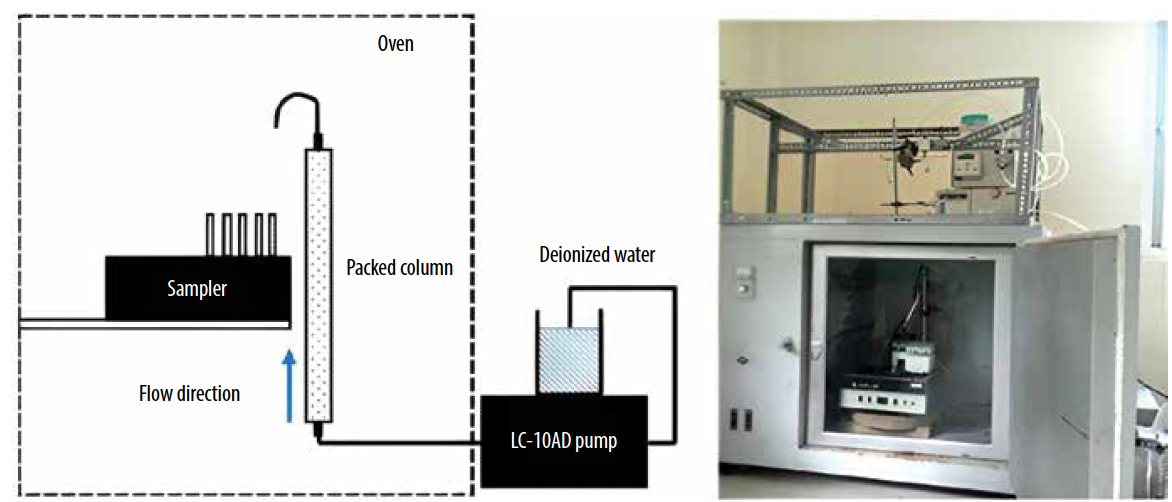
This paper presents an experimental study combined with an analytical model to evaluate the relationship between washed-out rate and partition coefficients of some short-chain alkylphenols during oil - water interaction. The water - oil displacement experiment was carried out on a column packing glass beads, in which the packed column was initially saturated with Su Tu Nau crude oil at a temperature of 40oC. Our research results show that in a given flow regime the washed-out rate of alkylphenols differentiates from each other mainly due to the partition coefficient, thereby suggesting the possibility of using alkylphenols as a tracer to determine residual oil saturation in the sweeping area of the injection water.
References
Marisa Ioppolo-Armanios, Robert Alexander, and Robert I. Kagi, “Geosynthesis of organic compounds: I. Alkylphenols”, Geochimica et Cosmochimica Acta, Volume 59, Issue 14, pp. 3017 - 3027, 1995. DOI: 10.1016/0016-7037(95)80001-8.
Marisa Ioppolo - Armanios, The occurrence and origins of some alkylphenols in crude oils. Curtin University of Technology, 1996.
Trevor P. Bastow, Ben G.K. van Aarssen, Geoff E. Chidlow, Robert Alexander, and Robert I. Kagi, “Small-scale and rapid quantitative analysis of phenols and carbazoles in sedimentary matter”, Organic Geochemistry, Volume 34, Issue 8, pp. 1113 - 1127, 2003. DOI: 10.1016/S0146-6380(03)00066-4.
Michael J. Borda, Alicia R. Elsetinow, Daniel R. Strongin, and Martin A. Schoonen, “A mechanism for the production of hydroxyl radical at surface defect sites on pyrite”, Geochimica et Cosmochimica Acta, Volume 67, Issue 5, pp. 935 - 939, 2003. DOI: 10.1016/S0016-7037(02)01222-X.
Trevor P. Bastow, Ben G.K. van Aarssen, Rober Alexander, and Rober I. Kagi, “Origins of alkylphenols in crude oils: Hydroxylation of alkylbenzenes”, Organic Geochemistry, Volume 36, Issue 7, pp. 991 - 1001, 2005. DOI: 10.1016/j.orggeochem.2005.03.007.
S. Zhou, H. Huang, “Controls on alkylphenol occurrence and distribution in oils from lacustrine rift basins in East China”, Science in China Series D: Earth Science, Volume 51, Issue 7, pp. 976 - 983, 2008. DOI: 10.1007/s11430-008-0066-8.
Li Su-mei et al., “Oxygenic compounds in crude oils-phenols”, Acta Petrol Sin (in Chinese), Volume 21, Issue 1, pp. 44 - 48, 2000. DOI: 10.7623/syxb200001008.
Sandra O.Lucach, Bernard F.J.Bowler, Neil Frewin, and Steve R.Larter, “Variation in alkylphenol distributions in a homogeneous oil suite form the Dhahaban petroleum system of Oman”, Organic Geochemistry, Volume 33, Issue 5, pp. 581 - 594, 2002. DOI: 10.1016/S0146-6380(02)00014-1.
Trevor P. Bastow, Ben G.K. van Aarssen, Robert Herman, Robert Alexander, and Robert I. Kagi, “The effect of oxidation on the distribution of alkylphenols in crude oils”, Organic Geochemistry, Volume 34, pp. 1103 -1111, 2003. DOI: 10.1016/S0146-6380(03)00067-6.
Dennis Taylor, A. E. Kotorovich, A.I. Larichev, and M. Glikson, “Petroleum source rocks in the Roper Group of the McArthur Basin: Source characterization and maturity determinations using physical and chemical method”, APEA, Volume 34, pp. 279 - 296, 1994. DOI: 10.1071/AJ93026.
B. Bennett and S.R. Larter, “Partition behaviour of alkylphenols in crude oil/brine systems under subsurface conditions”, Geochimica et Cosmochimica Acta, Volume 61, Issue 20, pp. 4393 - 4402, 1997. DOI: 10.1016/S0016-7037(97)88537-7.
R. Sinha, K.Asakawa, G.A.Pope, and K.Sepehmoori, “Simulation of natural and partitioning interwell tracers to calculate saturation and swept volumes in oil reservoirs”, SPE/DOE Symposium on Improved Oil Recovery, Tulsa, Oklahoma, 17 - 21 April, 2004. DOI: 10.2118/89458-MS.
To Ba Cuong, Nguyen Hong Phan, and Nguyen Huu Quang, “Interwell tracer method using partitioning compounds naturally existing in crude oil for determination of residual oil saturation”, Petrovietnam Journal, Volume 10, pp. 38 - 43, 2016.
Huynh Thi Thu Huong, Le Thanh Tai, Nguyen Huu Quang, and Le Van Son, “Determination of contribution proportion of injection wells in oil production by interwell tracer method using partitioning organic compounds from crude oil”, Petrovietnam Journal, Volume 6, pp. 24 - 29, 2019.
Huynh Thi Thu Huong, Nguyen Huu Quang, Le Van Son and Tran Trong Hieu, “Transport of oil/water partitioning components during water injection”, Petrovietnam Journal, Vol. 6, pp. 37 - 42, 2021. DOI: 10.47800/PVJ.2021.06-03.
Nguyễn Hồng Phan, Nguyễn Hữu Quang, Tô Bá Cường, Huỳnh Thị Thu Hương, và nnk, “Phát triển mô hình mô phỏng quá trình vận động của các chất chỉ thị tự nhiên (NPIT) để đánh giá trữ lượng dầu trong khai thác”, Viện Năng lượng Nguyên tử Việt Nam, 2015.
O. Huseby, A. Haugan, J. Sagen, J. Muller, B. Bennett, S.R. Larter, E.S. Kikkinides, A.K.Stubos, and F. Yousefian, Jean-Francois Thovert, and P.M. Adler, “Transport of organic components from immobile and bypassed oil in porous media”, Applied Chemical Engineering, Volume 49, Issue 5, pp. 1085 - 1094, 2003. DOI: 10.1002/aic.690490504.
Ann Muggeridge, Andrew Cockin, Kevin Webb, Harry Frampton, Ian Collins, Tim Moulds and Peter Salino, “Recovery rates, enhanced oil recovery and technological limits”, Philosophical Transactions of the Royal Society A, Volume 372, Issue 2006, 2014. DOI: 10.1098/rsta.2012.0320.
L. Lake, R.T. Johns, W.R. Rossen, and G.A. Pope, Fundamentals of enhanced oil recovery. Texas: Society of Petroleum Engineers, 2014.
P. Martínez-Pagán, A. Jardani, A. Revil, and A. Hass, “Self-potential monitoring of a salt plume”, Geophysics, Volume 75, Issue 4, 2010. DOI: 10.1190/1.3475533.
1. The Author assigns all copyright in and to the article (the Work) to the Petrovietnam Journal, including the right to publish, republish, transmit, sell and distribute the Work in whole or in part in electronic and print editions of the Journal, in all media of expression now known or later developed.
2. By this assignment of copyright to the Petrovietnam Journal, reproduction, posting, transmission, distribution or other use of the Work in whole or in part in any medium by the Author requires a full citation to the Journal, suitable in form and content as follows: title of article, authors’ names, journal title, volume, issue, year, copyright owner as specified in the Journal, DOI number. Links to the final article published on the website of the Journal are encouraged.