Increasing the flash point temperature of DCO oil products to meet the FO (FP) baseline standard of Dung Quat refinery
Abstract
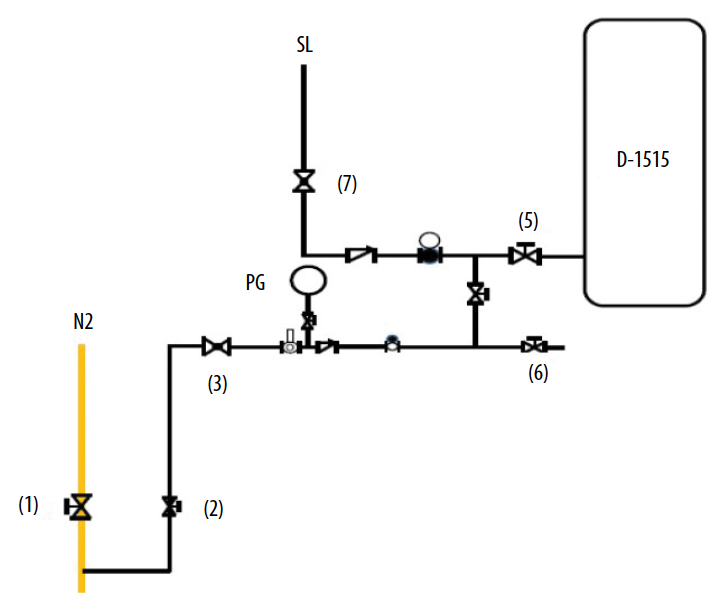
The flash point temperature of decanted oil (DCO) has been consistently low since the Dung Quat refinery commenced operations in 2009. This issue is attributed to the absorption of trace amounts of light gases such as H2, CH4, and C2H6 by the liquid stream at the bottom of the tower. These gases cannot be effectively separated through distillation at T-1501, and neither modifications to hardware nor adjustments to the angle of the fifth packing layer have proven effective. The separation of these light gases can only be achieved by applying the stripping method to the DCO product stream emanating from the bottom of the tower and at D-1515. This method must ensure no alterations to existing hardware and utilize current equipment solely. The technique involves injecting N2 directly into the liquid drum to remove light gases by reducing the partial pressure of hydrocarbons. This solution successfully increased the DCO flash point temperature from 49°C to 84°C in July 2018, and has been maintained to date. Furthermore, the flash point temperature can be regulated by the N2 stream to exceed 100°C, thereby meeting and surpassing the technical requirement of 66°C.
References
Reza Sadeghbeigi, Fluid catalytic cracking handbook. Butterworth-Heinemann, 2019.
1. The Author assigns all copyright in and to the article (the Work) to the Petrovietnam Journal, including the right to publish, republish, transmit, sell and distribute the Work in whole or in part in electronic and print editions of the Journal, in all media of expression now known or later developed.
2. By this assignment of copyright to the Petrovietnam Journal, reproduction, posting, transmission, distribution or other use of the Work in whole or in part in any medium by the Author requires a full citation to the Journal, suitable in form and content as follows: title of article, authors’ names, journal title, volume, issue, year, copyright owner as specified in the Journal, DOI number. Links to the final article published on the website of the Journal are encouraged.