Assessment of the greenhouse gas and sulfur dioxide emission reductions resulting from the transition of gasoline and diesel in Vietnam
Abstract
Vietnam has committed to a national voluntary emission reduction target of 15.8% by 2030 relative to the 2014 baseline, with the goal of achieving net-zero emissions by 2050. Currently, 48 million motorbikes and 2.4 million cars are registered nationwide.
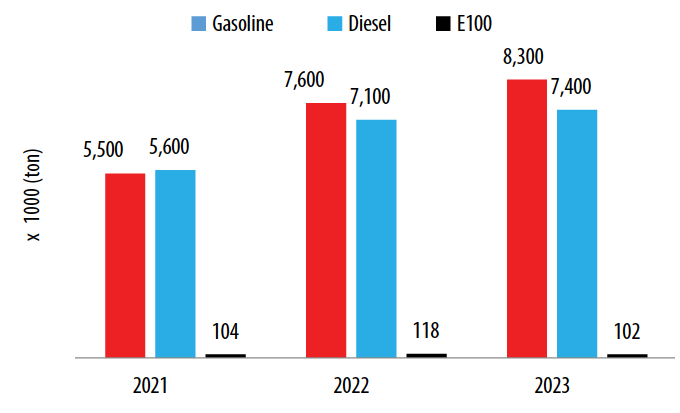
Domestic market supplies gasoline and diesel in Grades II, III and V, which differ in their sulfur content. In 2023, total gasoline and diesel consumption reached 15.8 million tons, resulting in the emission of 50 million tons of GHG and 9,800 tons of SO2. In response, the government issued Decision No. 876/QĐ-TTg to gradually transition the transport sector toward cleaner, greener fuels or electricity, targeting Vietnam’s net-zero by 2050. In this paper, the 2030 scenario, which involves switching to ethanol fuel and transitioning gasoline engines to electric vehicles, will be considered and discussed as a strategy to reduce both GHG and SO2 emissions. The results will be compared to the commitment of the Government.
References
Ministry of Natural Resources and Environment, Report on National GHG inventory for 2016, 2020.
Vietnam, Nationally determined contribution (NDC), 2022.
Jung Eun Oh, Maria Cordeiro, John Allen Rogers, Khanh Nguyen, Daniel Bongardt, Ly Tuyet Dang, and Vu Anh Tuan, “Addressing climate change in transport: Volume 1: Pathway to low-carbon transport”, 2019.
Tarek Keskes, Chiara Odetta Rogate, Zayra Romo, Shigeyuki Sakaki, and Bowen Wang, “Viet Nam - Recommendations to the national roadmap and action plan for the electric-mobility transition: Executive Version (English)”. [Online]. Available: https://documents.worldbank.org/en/publication/documents-reports/documentdetail/099102224045529146.
ADB, “Guidelines for estimating greenhouse gas emissions of Asian development bank projects: Additional guidance for transport projects”, 2016. [Online]. Available: https://www.adb.org/sites/default/files/institutional-document/219791/guidelines-estimating-ghg-emissions-transport.pdf.
Petrolimex, Báo cáo phát triển bền vững, 2023.
PVOIL, Báo cáo thường niên, 2020 - 2022.
Ministry of Industry and Trade of the Socialist Republic of Vietnam, Information on fuel price management. [Online]. Available: https://moit.gov.vn/tin-tuc/thong-bao/thong-tin-dieu-hanh-gia-xang-dau-ngay-28-12-2023.html.
IEA, “Where does Vietnam get its energy?”. [Online]. Available: https://www.iea.org/countries/viet-nam/energy-mix.
Danish Energy Agency, “Viet Nam energy outlook report: Pathways to net-zero”, 2024. [Online]. Available: https://ens.dk/sites/ens.dk/files/Globalcooperation/1._eor-nz_english_june2024_0.pdf.
Dinh-Son Tran, Huong Le, and Zifei Yang, “Two-wheelers in Vietnam: A baseline analysis of fleet characteristics and fuel consumption in 2019 and 2020”, 2022. [Online]. Available:https://theicct.org/publication/2w-lvs-vietnam-asia-baseline-feb22/.
Huong Le, Francisco Posada, and Zifei Yang, “Assessment of electric two-wheelers development in Vietnam: An overview”, 2022. [Online]. Available: https://theicct.org/wp-content/uploads/2022/10/asia-pacific-lvs-NDC-TIA-E2W-mkt-growth-Vietnam-nov22.pdf.
Dinh Van Hiep, Nam Hoai Tran, Nguyen Anh Tuan, Tran Manh Hung, Ngo Viet Duc, and Hoang Tung, “Assessment of electric two-wheelers development in establishing a national E-mobility roadmap to promote sustainable transport in Vietnam”, Sustainability, Volume 15, Issue 9, 2023. DOI: 10.3390/su15097411.
BMI, “Vietnam EV profile: VinFast to provide a strong boost to BEV sales”, 2023. [Online]. Available: https://www.fitchsolutions.com/bmi/autos/vietnam-ev-profile-vinfast-provide-strong-boost-bev-sales-03-08-2023.
1. The Author assigns all copyright in and to the article (the Work) to the Petrovietnam Journal, including the right to publish, republish, transmit, sell and distribute the Work in whole or in part in electronic and print editions of the Journal, in all media of expression now known or later developed.
2. By this assignment of copyright to the Petrovietnam Journal, reproduction, posting, transmission, distribution or other use of the Work in whole or in part in any medium by the Author requires a full citation to the Journal, suitable in form and content as follows: title of article, authors’ names, journal title, volume, issue, year, copyright owner as specified in the Journal, DOI number. Links to the final article published on the website of the Journal are encouraged.